 CasinoCheck Tanzania
ThroneBet Tanzania: licence, domain and risk checks
An advert or social post can make a betting service appear familiar before the address behind it has been checked. For ThroneBet, the safer journey starts by ignoring the promotional button, reading the destination hostname and comparing the operator identity with current public records. The observed public-facing address in the evidence packet is thronebettanzania.com, while the named operator is Throne Bet Ltd.
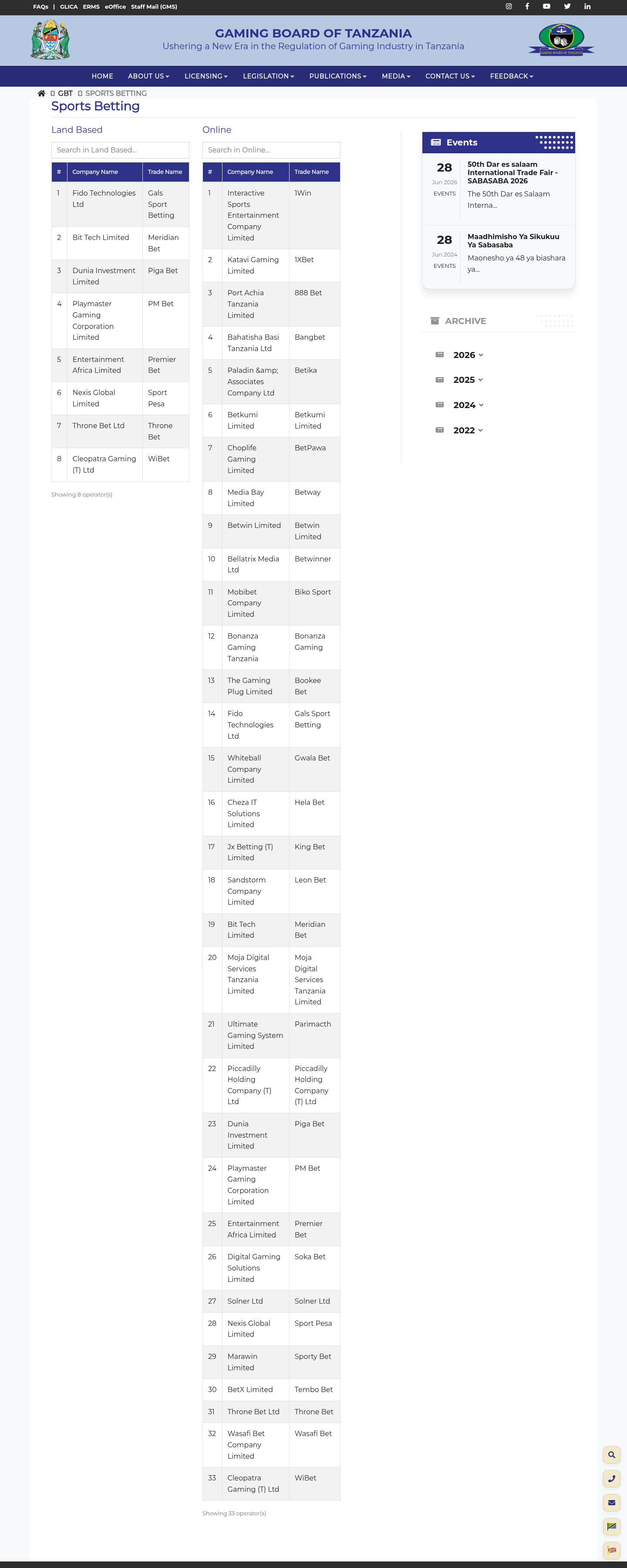
The available records provide a useful identity trail, but they do not complete it. The Gaming Board of Tanzania’s online sports-betting table identifies Throne Bet Ltd and the trade name Throne Bet. Tanzania Sports Betting Association material supplies contextual support connecting the brand with a domain. However, the packet contains neither a licence certificate nor a regulator record explicitly binding the exact hostname thronebettanzania.com to a current licence. The result is an amber signal: there is meaningful public-record support for the operator name, but the certificate, precise domain binding and licence expiry remain open.

Verdict: scam or legit in Tanzania?
The verified packet does not support calling ThroneBet a scam. It also does not justify an unqualified statement that every site, advert or app using the name is licensed. The strongest evidence is the regulator’s current public table, checked on 20 August 2026, which lists the company and trade name in the online sports-betting context. That is important entity-level evidence.
The unresolved issue is narrower but material: no supplied primary record displays the exact domain beside a licence number, certificate status or expiry date. Association material helps connect the public-facing identity with a domain, but an industry membership page is not a substitute for a regulator-issued certificate. Users should therefore treat the service as partially verified rather than fully cleared.
| Question | Evidence result | Practical meaning |
|---|---|---|
| Is the operator name found in a current regulator table? | Yes: Throne Bet Ltd / Throne Bet | Supports the existence of a recognised operator and trade name |
Is thronebettanzania.com explicitly bound to that operator by the supplied regulator record? | Not shown | Confirm the hostname before registration or payment |
| Is a licence certificate supplied? | No | Certificate number, scope and conditions cannot be checked here |
| Is a licence expiry date established? | No | Current validity cannot be inferred from a blank expiry field |
| Is there an official adverse finding in the packet? | No | A red signal is not supported |
This amber conclusion is deliberately narrower than either “scam” or “fully verified”. It records what the evidence establishes and preserves the open questions that matter when money or identity documents are involved.
Hostname proof from advert to account screen
A mobile acquisition trail can pass through an advert, shortened link, messaging app, browser redirect and installation prompt. Brand colours and familiar wording are weak identifiers because they can be copied. The decisive text is the hostname displayed by the browser before account creation, login, document upload or payment.
For this review, the observed operator-facing host is thronebettanzania.com. Type or inspect that spelling character by character. Look for inserted hyphens, doubled letters, swapped endings, extra words before or after the name, and misleading subdomains. A padlock only indicates an encrypted connection to the displayed host; it does not prove that the host belongs to the licensed entity.
If an advert lands on another address, do not assume that it is an approved mirror. Return to a separately verified starting point and compare the address again. An app should receive the same scrutiny: establish who distributes it, what hostname handles login and payments, and whether the operator identity shown in its legal information matches Throne Bet Ltd. None of those app details is established by the packet.
Operator, trade name and licence match
The Gaming Board of Tanzania online sports-betting table is the principal record. Checked on 20 August 2026, it identifies Throne Bet Ltd and Throne Bet within its public company and trade-name listing. That supports an operator-to-brand relationship at the entity level.
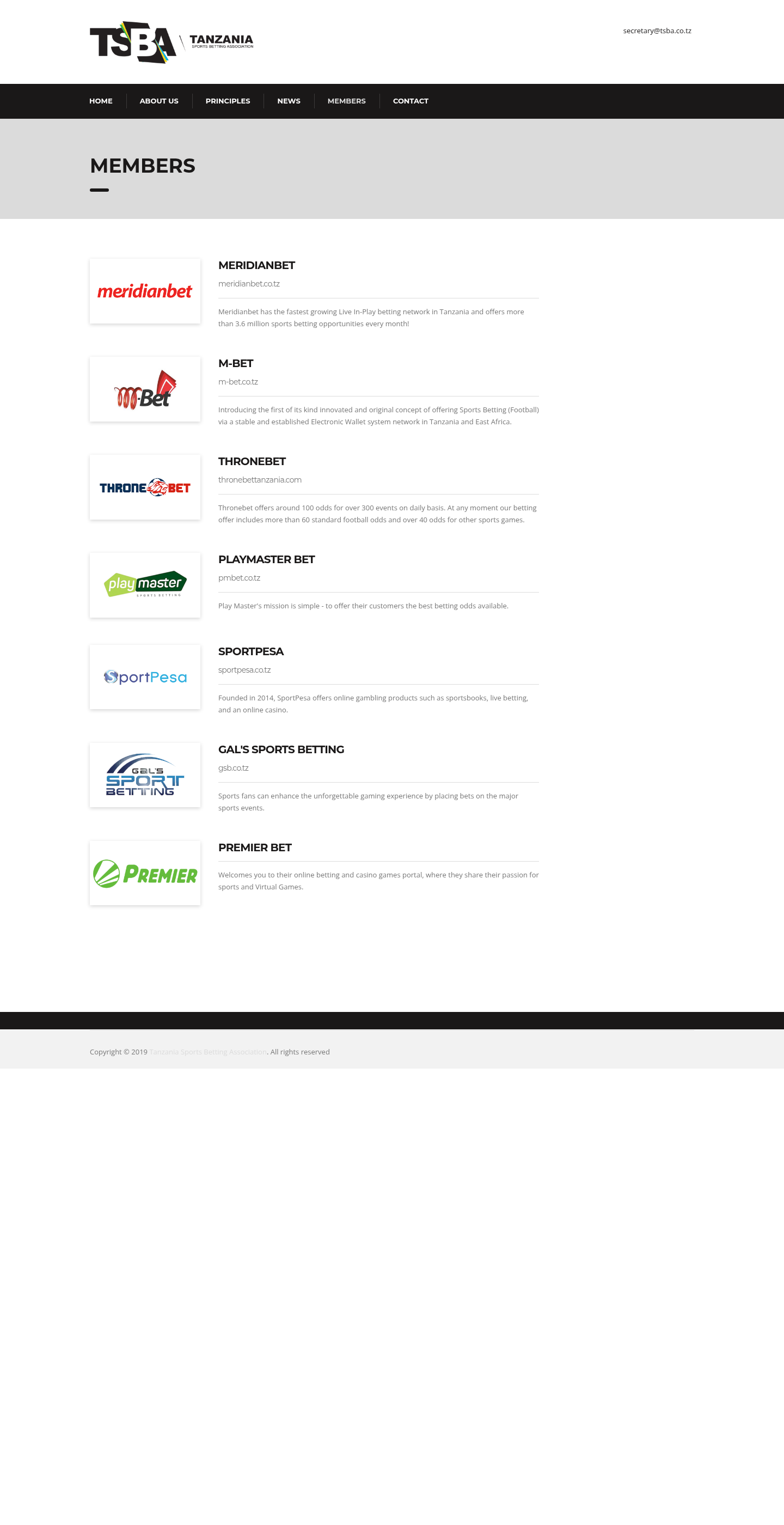
The Tanzania Sports Betting Association member page adds context by associating several trade names with public-facing domains, including this operator’s brand. The same source also provides comparison context for SportPesa, PMBet, MeridianBet, Premier Bet and Gal Sport Betting. Those comparisons show how association material can help trace a trading identity to a public address, but they do not elevate an association entry into a licensing decision.
| Identity layer | What is supported | What remains open |
|---|---|---|
| Legal operator | Throne Bet Ltd appears in the regulator’s public table | Corporate registration details are not supplied |
| Trade name | Throne Bet is associated with the listed company | Other spellings or similarly named services are not covered |
| Public host | thronebettanzania.com was observed and has association context | Explicit regulator-to-domain binding is absent |
| Licence | The company/trade name appears in an online betting list | Certificate, number, scope, conditions and expiry are not supplied |
Payments, browser flow and app risk
No payment method, minimum deposit, fee, processing time or mobile-money partner is verified in the packet. It would therefore be unsafe to claim support for M-Pesa, Airtel Money, Tigo Pesa, HaloPesa, cards, bank transfers or any other channel. A payment logo seen in an advert or cashier should be treated as an operator claim until independently confirmed within the correct host and against the payment provider’s own transaction details.
Before paying, record the exact hostname, account identifier, amount, recipient or merchant name, fee and displayed transaction reference. The recipient identity should make sense in relation to the operator; a demand to send funds to an unexplained personal number is a reason to stop and seek clarification. Do not move from a verified browser session to an unrelated messaging contact merely because someone claims to handle “manual deposits”.
| Payment-stage check | Acceptable evidence | Stop signal |
|---|---|---|
| Entry point | Correctly spelled verified hostname | Redirect to an unexplained lookalike host |
| Recipient | Merchant identity that can be reconciled with the service | Unexplained personal account or changing recipient |
| Amount and fee | Total shown before confirmation | Fee disclosed only after payment |
| Transaction record | Provider receipt and operator reference retained | Request to delete messages or receipts |
| Support contact | Contact reached through a verified route | Pressure to continue through a private account |
For broader preparation before funding any betting account, use the internal payment checks. The packet does not establish whether browser and app cashier paths are identical, so verify each route rather than assuming that one confirms the other.
Withdrawals, KYC and account control
There is no withdrawal test in the evidence. No verified record states the minimum withdrawal, normal processing period, daily ceiling, reversal policy or fee. A fast deposit does not predict a fast withdrawal, and an operator listing does not prove the outcome of an individual transaction.
KYC requirements are also unverified. Do not infer which identity documents are accepted, when checks begin, whether address evidence is required or how long review takes. Before depositing, read the account terms presented on the confirmed host and preserve a copy of the rules that apply at that time. If a withdrawal is delayed, retain the request timestamp, status changes, transaction references and exact support responses.
Only upload identity documents inside a verified account route after confirming why they are needed and how they will be handled. Do not send an identity image, one-time code, password or complete payment credential to a person contacting you through social media. If support asks for additional material, request a clear explanation and submit only through a channel whose connection to the operator can be established.
A small initial amount can limit exposure, but it is not a licence test and does not guarantee later withdrawals. Never deposit more merely because a message says another payment will “unlock” existing funds. That pattern should be documented and escalated rather than followed automatically.
Complaint route and evidence capture
Start with the operator’s official support route on the verified host. State the account identifier, disputed amount, relevant dates, transaction references and the remedy requested. Keep the message factual. Save the submitted text, acknowledgement, case number and each response; screenshots should include the address or app context where possible.
If the matter is not resolved, the Gaming Board portal describes complaint, registry-inspection and voluntary self-exclusion functions. Its inclusion in the packet supports it as a regulator-facing route, but it does not establish how the Board will decide a particular dispute. Follow the portal’s current instructions and provide records rather than conclusions that cannot be demonstrated.
A useful complaint bundle contains:
- the exact hostname and route used;
- account and transaction references;
- deposit or withdrawal receipts;
- timestamps and status changes;
- the applicable term or rule as displayed;
- support correspondence and case numbers; and
- a concise statement of the requested resolution.
Do not publish identity documents, phone numbers or full financial credentials while seeking public help. Guidance on organising a dispute is available under complaints and warnings. If gambling is causing immediate financial or personal harm, use urgent help rather than continuing to deposit while a complaint is pending.
Clone checks and material risks
The main evidence gap creates a practical clone risk: the entity and trade name have primary support, but the exact host is not explicitly bound by the supplied regulator record. A copied logo, near-identical address or social profile could exploit that gap. Treat every fresh advert as a new route to verify, even if an earlier session was genuine.
Check the full address before entering a password. A subdomain such as a familiar word placed before an unrelated base domain still belongs to the unrelated base domain. Be cautious when a link opens an installation file, asks for browser security settings to be weakened, or directs payment outside the account cashier. The packet does not verify any alternative domains, mirrors, agents, downloadable apps or social accounts.
The absence of an official adverse record is not proof that no user has experienced a problem. Equally, an isolated user allegation would not prove fraud without documentation and corroboration. The correct signal stays amber because the current evidence supports the named operator while leaving the host-to-certificate chain incomplete. Responsible-play options and limits should be considered before registration; see responsible gambling for practical controls.
Evidence chronology, limits and methodology
All accepted records were checked on 20 August 2026. The regulator table supplied the strongest operator and trade-name evidence. Association material supplied domain and market context. The operator homepage supplied only the observed public-facing address and self-presentation; it was not treated as independent licence proof. No user-report source was supplied, so no complaint pattern or reputation score is asserted.
| Date checked | Record role | Supported conclusion | Limit |
|---|---|---|---|
| 20 August 2026 | Gaming Board operator table | Throne Bet Ltd / Throne Bet appears in the public online sports-betting listing | No certificate or exact-host binding supplied |
| 20 August 2026 | Association member material | Context links the trading identity with a domain and shows comparable member-domain patterns | Association context is not a licensing certificate |
| 20 August 2026 | Operator-facing host | thronebettanzania.com was observed as the public-facing domain | Self-presentation is not independent verification |
| 20 August 2026 | Board client portal | Complaint, registry and voluntary self-exclusion functions are described | No case outcome or response time is established |
The assessment uses source roles rather than blending them. Primary records can support regulatory and complaint-route facts. Association records provide identity context. Operator statements describe what the service presents about itself. Unknown payment, withdrawal, KYC, certificate and expiry details remain unknown. The methodology and signal rules are set out under methodology.
Evidence can change after the checked date. A later regulator update, certificate, domain notice or official adverse action could alter the signal. Corrections should identify the disputed sentence and provide a dated competent record through contact. Unsupported promotional claims, anonymous assertions and undated screenshots are not enough to replace a primary record.
For readers who have independently checked the hostname, understood the amber limits and decided to continue, Check options. This is the only commercial route included, and it does not remove the need to re-check the destination before entering information or money.
Frequently asked questions
Is ThroneBet legit in Tanzania?
The Gaming Board of Tanzania’s public online sports-betting table identifies Throne Bet Ltd and the trade name Throne Bet. However, the supplied evidence does not include a licence certificate or an explicit regulator record binding `thronebettanzania.com` to that licence. The evidence therefore supports an amber, partially verified assessment rather than an unqualified approval.
Is ThroneBet a scam?
No supplied official adverse record or corroborated documented evidence establishes that it is a scam. The packet nevertheless leaves the exact domain-to-certificate connection, licence expiry, payments, withdrawals and KYC rules unresolved. Users should verify the hostname and transaction details instead of treating the absence of an adverse record as a guarantee.
Which website address was checked?
The observed public-facing address was `thronebettanzania.com`. Check that spelling in the browser before registering, logging in, uploading documents or paying. No alternative domain, mirror, app download address, agent account or social profile is verified by the supplied records.
Which payment and withdrawal methods are confirmed?
None. The packet verifies no mobile-money provider, card option, bank method, minimum amount, fee or processing time. Confirm the cashier details on the correct host, inspect the recipient identity and retain the provider receipt. There is also no completed withdrawal test on which to base a speed or reliability claim.
What should I do if a withdrawal is delayed?
Keep the withdrawal reference, amount, request time, status history, relevant terms and all support replies. Ask the operator for a case number and a specific explanation. If the issue remains unresolved, use the Gaming Board complaint route and submit a concise evidence bundle without exposing passwords, one-time codes or full identity documents publicly.
How can I report a correction or newer licence record?
Send the disputed wording together with a dated regulator record, certificate or other competent source through the internal contact route. A correction should distinguish the legal operator, trade name, exact hostname, licence scope and validity date so that one identity layer is not mistaken for another.